Electronic Design
Accuracy, battery life, unit cost and whether it passes EMC are all decided on the schematic months before anyone can measure them.
" height="4px" id="hRZSFU08U" width="973px"/></svg>)
By the time a product fails EMC testing, or comes back with half the battery life the pitch deck promised, the decisions that caused it are six months old and buried several layers down in a PCB. Undoing them means a respin, sometimes new tooling, and a test-house slot you have already booked and paid for.
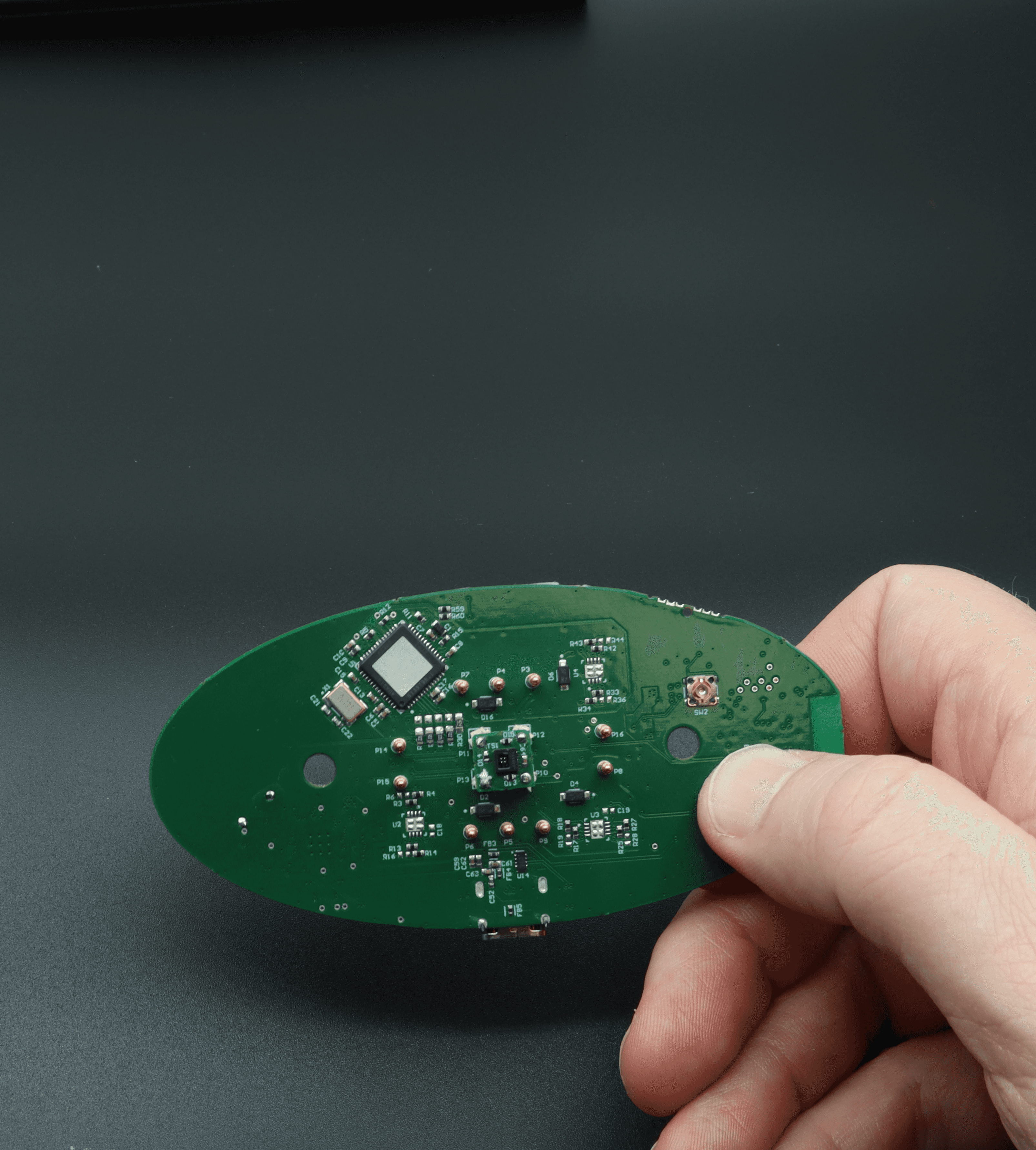
Most of what a device will and will not be able to do is fixed at architecture and schematic stage: what it can sense and how accurately, how long it runs between charges, what it costs to build at volume, and how much margin it has when it reaches compliance testing. We design boards with those constraints written down at the start and measured as we go, rather than discovered at the end.
We also write the firmware and build the enclosure, so the board gets drawn knowing what the code will have to do with it and what it has to fit inside.
Precise heat, close to the eye, in something light enough to wear
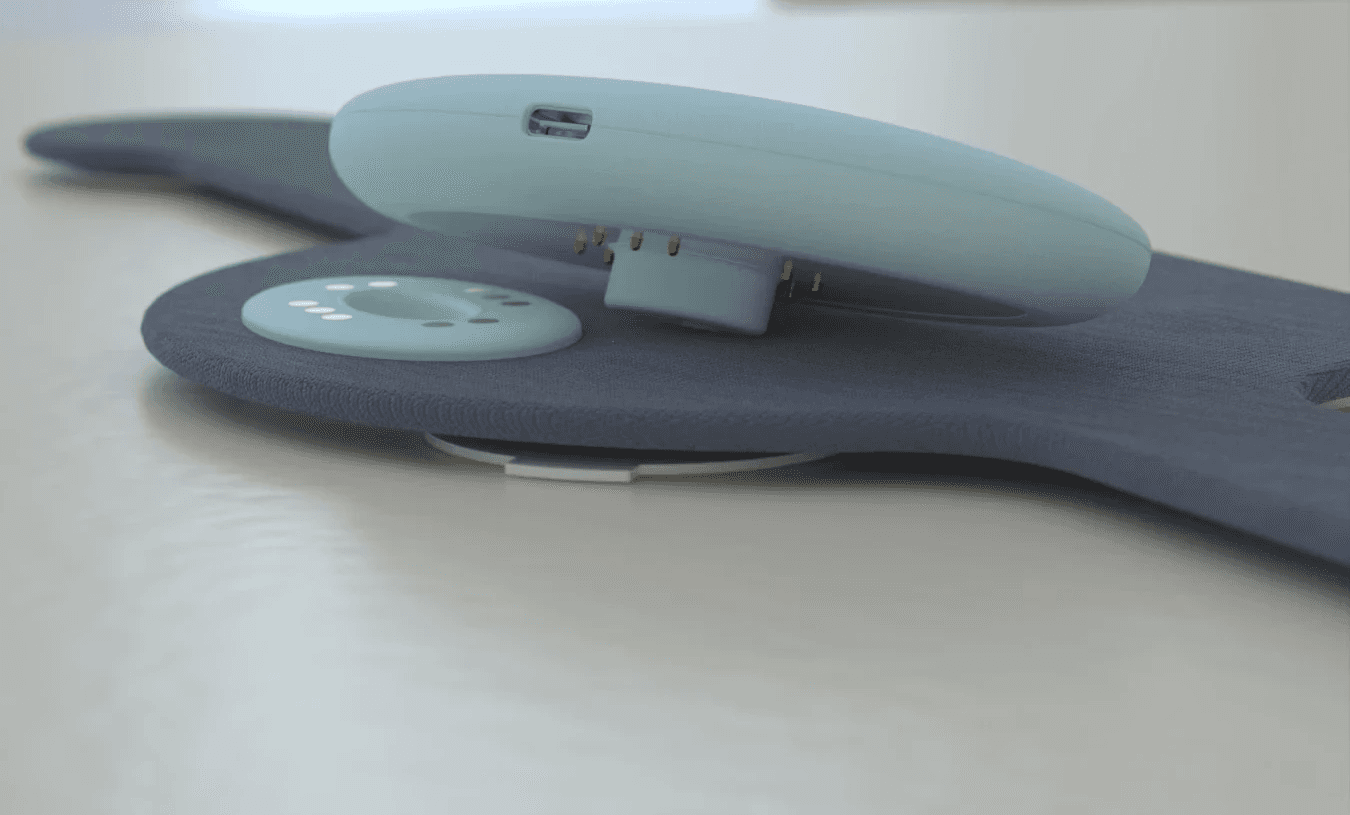
Lia Eyecare came to us with nightleaf as a university research concept: a wearable device that treats dry eye disease by delivering controlled, stable temperature to the eyelid. We led the electronics, firmware and thermal engineering, and we are now taking it through design for manufacture ahead of its first production run.
Delivering heat that close to sensitive tissue leaves very little margin. The device has to hold its temperature precisely and repeatably, demonstrate that it is safe, and still be light enough that somebody will wear it on their face. We began with thermal simulation of the thermoelectric modules and sensing plates to find where heat was genuinely accumulating, then designed the custom electronics and closed‑loop firmware that regulate it in real time. Several rounds of prototypes followed, each one checking that measured behaviour matched the model.

"Their thermal analysis work was particularly important to validating the core mechanism of our technology, controlled thermal modulation of the eyelid, and they are now supporting us through design for manufacture as we prepare for our first production run."
Sinéad Buckley, Co‑Founder & COO, Lia Eyecare

When the heat sink and the battery need the same space
nightleaf sits on someone's head, so its volume was fixed early and was never going to grow. Inside it, two things compete for the same space. The frame holding the battery is also the heat sink: make it larger and the device runs cooler and sits further inside its safety margin, but every millimetre it gains, the battery loses in capacity and runtime goes with it. Shrink it to protect the battery and the thermal performance goes instead. Neither discipline can solve that alone. A mechanical engineer optimising the housing hands the electronics team a runtime problem; an electronics engineer protecting the battery hands back a thermal one. Our two teams worked it against a single thermal model, so the trade‑off could be optimised rather than simply accepted.
What we do
" height="4px" id="hcyQGd7cR" width="262px"/></svg>)

Analogue, digital, mixed‑signal and power electronics, from block diagram to reviewed schematic. This is the stage where your cost, accuracy and power budgets are actually set, so it is where we spend disproportionate time and where we will push back hardest on a requirement that is going to be expensive.

Sensing and analogue front ends
Getting a small signal out of a noisy world and into a number you can trust. Sensor selection, amplification and filtering, ADC choice, calibration, and the noise, offset and thermal drift budget that decides whether your accuracy claim survives contact with a real environment.

PCB layout, including flex and rigid-flex
Multilayer, high‑density, high‑speed and mixed‑signal layout, with signal integrity, power integrity, controlled‑impedance routing and thermal performance handled deliberately rather than hoped for. Flex and rigid‑flex where the product has to bend, wrap or fit somewhere a rigid board will not go.

Power and battery architecture
Battery chemistry and capacity, charging topology, power paths, regulation and sequencing, and a measured power budget rather than an estimated one. Firmware can protect a good power architecture; it cannot rescue a bad one, which is why this is decided here.

Designing to pass EMC and safety the first time
Emissions and immunity considered at layout rather than diagnosed afterwards, with creepage and clearance, isolation and protection designed in from the start. Where it is worth it, we pre‑screen before booking a test house, because a failed slot costs weeks, not just fees.

Component choice, supply and cost at volume
Parts chosen for availability, lifecycle and second‑source options as well as performance, because the best component in the world is no use if it is on eighteen weeks' lead time when you want to build. Bill‑of‑materials cost tracked as a design constraint, with design for manufacture and assembly reviewed before the first prototype rather than after the first production run.
Talk to whom you will be working with
" height="4px" id="j7DaIfjlS" width="730px"/></svg>)

Vladyslav Denyshchenko
Electronic Engineer
Vlad is an embedded design engineer who works across the full hardware cycle, from custom schematics and PCB design through to the firmware that drives the board. His layout work includes routing high-frequency signals, and he is as comfortable on the bench as at a workstation soldering prototypes by hand, and tracing awkward faults with an oscilloscope. It means the engineer who drew the schematic is the one holding the probe when the first board powers up.
Frequently Asked Question
When should I bring an electronic engineer into my project?
Ideally as early as possible. Even at the concept stage, electronic engineering input can help you understand what’s technically feasible, what might be costly or risky, and how your idea could scale into a real product. Early involvement often saves time and avoids expensive redesigns later on.