Mechanical Design
Nobody can tell you how a device feels from a render. You have to make it, hold it, and then make the next one.
" height="4px" id="hRZSFU08U" width="973px"/></svg>)
An enclosure is usually the last thing designed and the first thing a user judges. By the time it starts, the board outline is fixed, the battery is chosen and the mounting points are wherever the electronics ended up, so mechanical design becomes the work of accommodating other people's decisions rather than shaping them.
The second failure is quieter. A device can be correct in CAD, pass every tolerance check and still be unpleasant to hold, awkward to put on, or ambiguous about which way round it goes. None of that is visible on a screen.
We design the enclosure alongside the board and the firmware rather than after them, and we prototype in‑house. That keeps the loop between drawing something and holding it short enough to run it many times.
From a cable and two stacked boards to one board and a magnet
Onawave's EndoSolve delivers electrical stimulation therapy for endometriosis a condition affecting millions of women that often takes years to diagnose. It is worn discreetly, for long stretches, by people who are already in pain. That puts unusual weight on how a device feels rather than on what it can do.
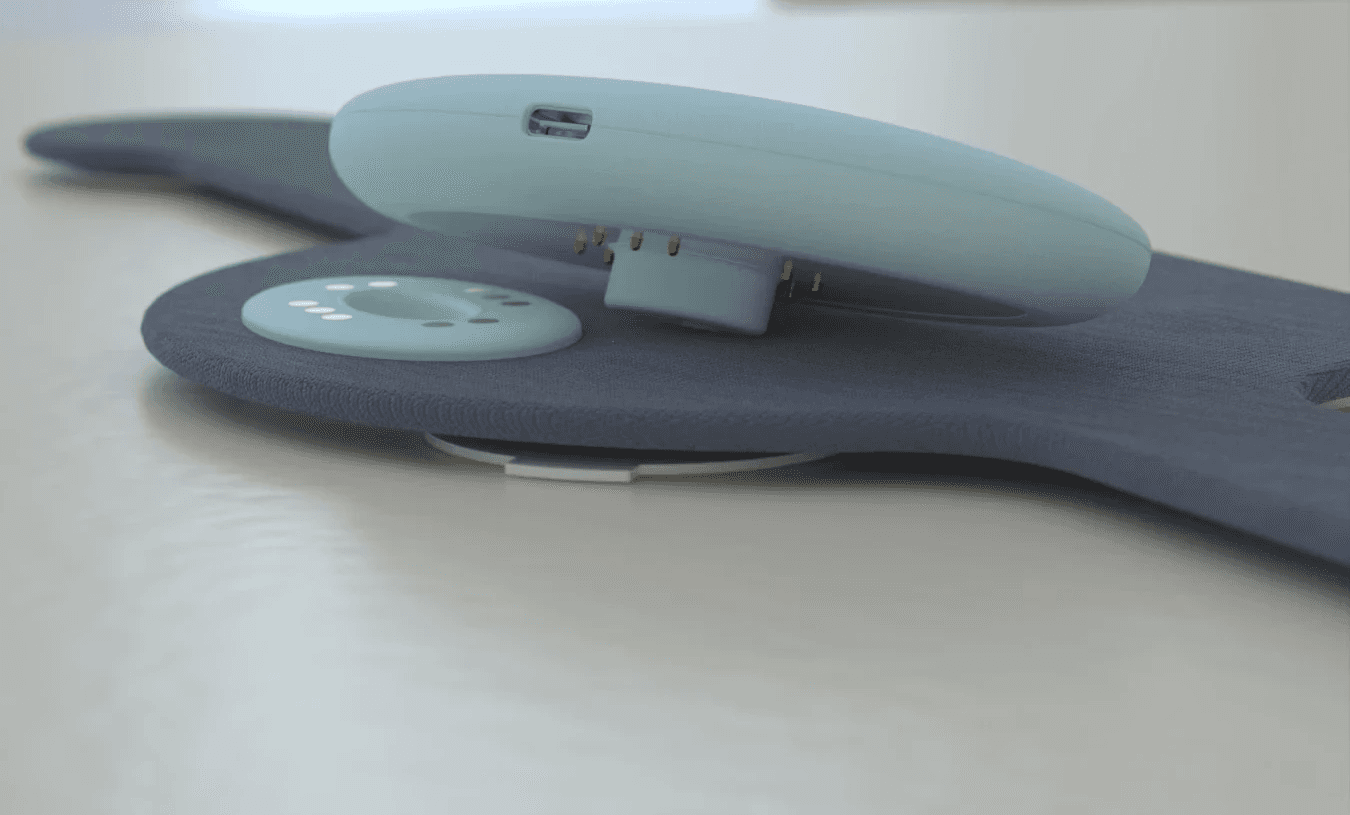
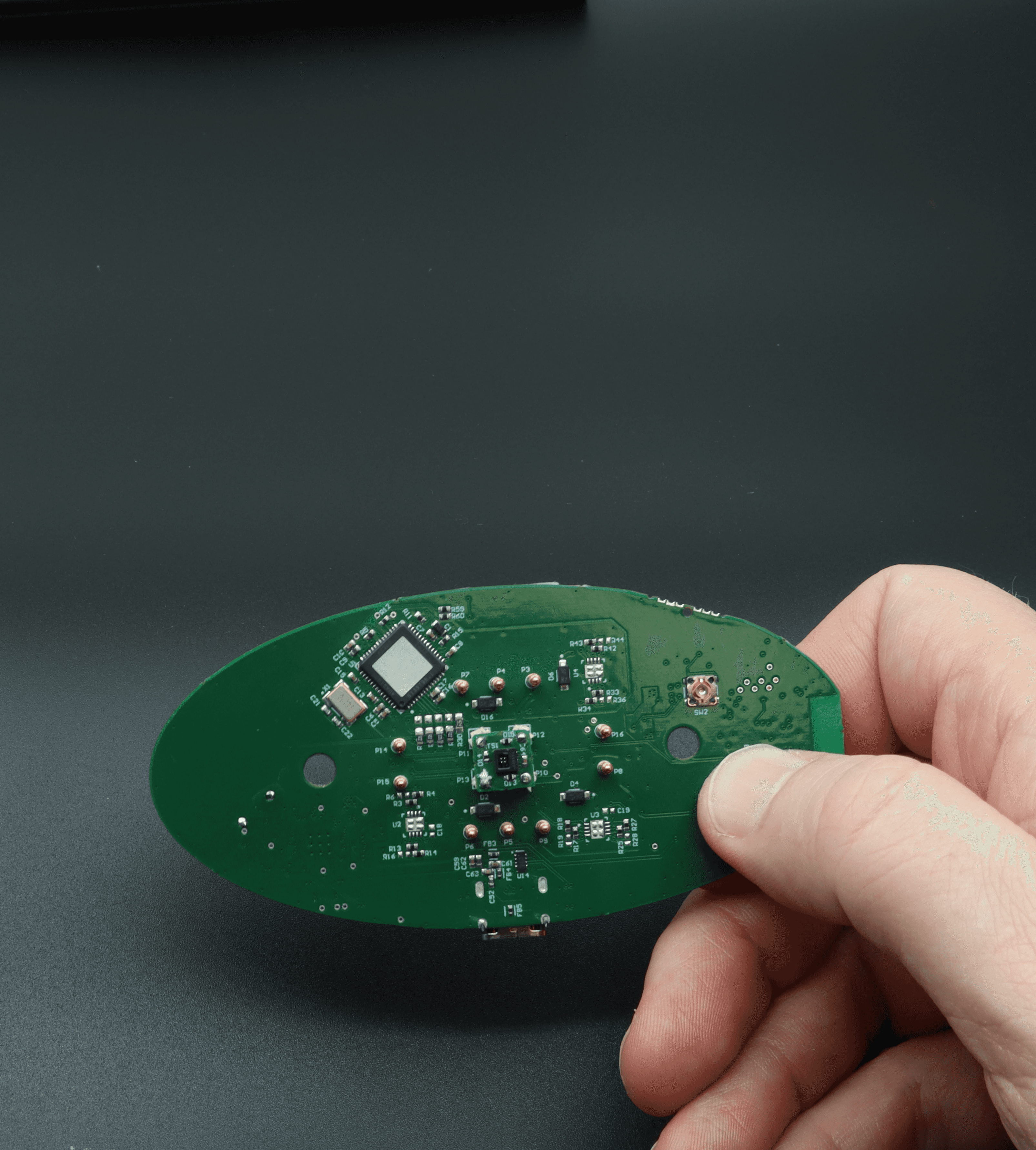
The early concept stacked two PCBs and ran the electrodes on a cable. We rebuilt the internal architecture onto a single board, which made the device smaller, cheaper to manufacture and simpler to assemble and gave the enclosure the room it needed to become something a person would actually wear. Then we removed the cable altogether in favour of interchangeable patches: a nylon‑lined spacer mesh chosen to stay comfortable and cleanable against skin, and a magnetic alignment system to remove the chance of user error.

"IMME Design supported us from early proof of concept through to full product development, including electronics, firmware, mechanical design, app development, and the prototypes used in our field studies. Their ability to deliver across these disciplines as a single, integrated team made a significant difference."
John Hegarty, COO, OnaWave Medical

You can't simulate how something feels
The attachment was the hard part. A pod holding the electronics clips onto a flexible pad, the pad carries the electrodes, and the electrodes sit against the body. Every one of those interfaces had to be secure, repeatable and obvious to somebody using it for the first time, without adding bulk to the device.
Alignment and tolerance can be checked in CAD. Whether a magnet lands with a reassuring click or a flimsy one cannot, and neither can whether a patch comes away cleanly with one hand. So we built prototype after prototype and passed them round, to ourselves and to Onawave, until the look was right and more to the point the feel was. Having every discipline in‑house is what made that many iterations affordable.
What we do
" height="4px" id="hcyQGd7cR" width="262px"/></svg>)

How a product looks, and more importantly how it sits in a hand or against a body. Form, proportion and finish, worked out against what the device actually has to contain so the concept that gets approved is one that can still be built when the electronics go in.

Enclosure and mechanism design
Housings, covers, hinges, catches, seals and moving parts. Tolerance stacks worked through properly, so parts fit at the tolerances a real moulder will hold rather than the ones a model assumes.

Designing around the electronics, not after them
Board outline, connector and port placement, flex PCB routing through the enclosure, mounting, and the thermal paths that carry heat away from where it is generated. When the mechanical and electronic decisions are made in the same room, the enclosure shapes the board as much as the board shapes the enclosure.

Materials, finishes and skin contact
Material selection for durability, cleanability, weight and cost and for comfort where a product is worn. On EndoSolve that meant a nylon‑lined spacer mesh that had to stay pleasant against skin through repeated use and cleaning.

Prototyping in-house
Appearance models to judge form, functional prototypes to test mechanisms, and working units robust enough for field studies and user testing. Made here, which is why we can afford to be wrong a few times before we are right.

Design for manufacture
Draft angles, wall sections, tooling strategy and assembly sequence, with the part count and the number of assembly steps treated as costs to be argued down. Getting from ten units to a thousand is a different problem from getting to ten, and it is easier if the first ten were drawn with the thousand in mind.
Talk to whom you will be working with
" height="4px" id="j7DaIfjlS" width="730px"/></svg>)

Matthew Kaye Mellor
Mechanical Engineer
Matthew brings a designer's mindset to engineering, so form and function end up in harmony rather than in competition. He works in 3D software and in physical space, and runs simulation across mechanical, fluid and thermal behaviour, which is exactly why he knows where simulation stops. A model tells you whether a part survives, flexes or sheds heat. It cannot tell you whether the thing is good to hold. That is what the prototypes are for.
Frequently Asked Question
Is this about how the product looks, how it works, or both?
Both. Mechanical and industrial design cover everything from structure and durability to ergonomics and visual appeal. A successful product feels good to use, works reliably, and can be manufactured realistically at scale.